Worktop materials guide
The worktop is the bit you touch every day.
Most worktop regret comes from choosing a material for how it looks in a showroom rather than how it behaves in a kitchen with children, red wine and hot pans in it. Here is an honest run through the options — what each one is genuinely good at, what it asks of you, and where it will let you down. No brand names, no sales pressure, just the things worth knowing before you choose.
01
Worktop material
Engineered Quartz
Best for: Busy family kitchens · consistent colour · low maintenance
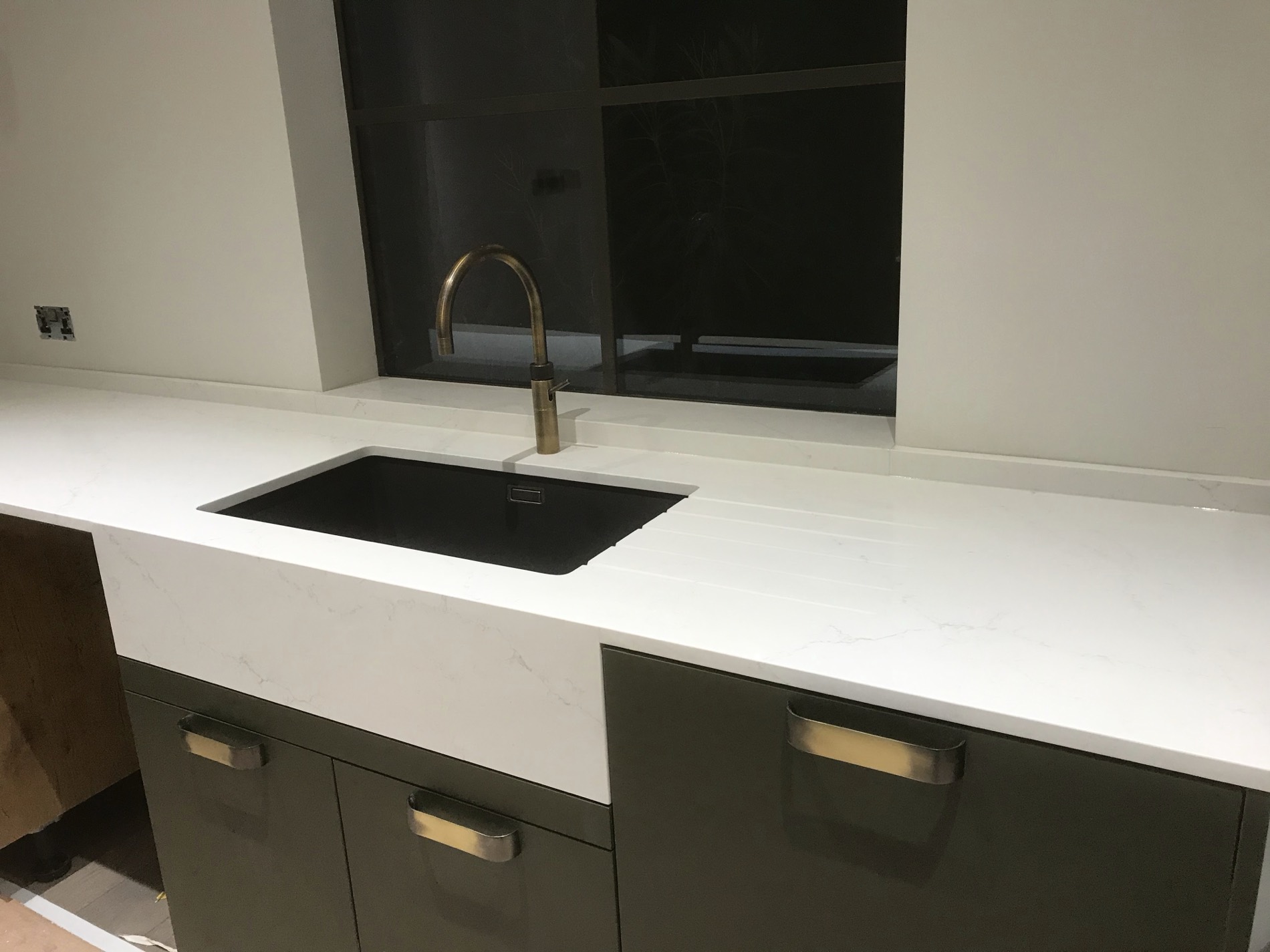
Quartz is roughly 90% ground natural quartz bound with resin and pigment, which makes it non-porous, consistent from slab to slab and effectively maintenance-free — no sealing, and nothing to do beyond soap and water. It is the default choice in most modern kitchens for good reason: it takes a mitred edge beautifully, it can be supplied in whites and pale greys that natural stone simply doesn't offer reliably, and the colour you approve is the colour you get. Its limits are heat and ultraviolet light: the resin can scorch, so pans come off the hob onto a trivet, and strong direct sunlight over years can shift the colour of some shades, which matters in a south-facing garden-room extension.
- Non-porous
- No sealing needed
- Use a trivet for hot pans
02
Worktop material
Granite
Best for: Character and movement · heat tolerance · one-off slabs
Granite is the natural stone that behaves best in a kitchen: genuinely hard, genuinely heat-tolerant, and full of movement and depth that no engineered product quite imitates. Because it comes out of the ground, every slab is different — which is the argument for going to the yard and choosing yours rather than ordering from a 100mm sample. Darker granites are dense and need very little attention; lighter and more decorative ones are more porous and benefit from periodic sealing to stop oil and red wine marking. Polished, honed and leathered finishes all change the look substantially, so ask to see the same stone in more than one finish before committing.
- Every slab unique
- Very heat-tolerant
- Seal lighter stones
03
Worktop material
Sintered Stone & Porcelain
Best for: Ultra-slim tops · outdoor kitchens · heat and UV resistance
Sintered stone and large-format porcelain are made by compacting mineral powders under extreme pressure and heat, producing a surface that is exceptionally hard, entirely non-porous, resistant to scratching and stains and — unusually — unbothered by hot pans and by direct sunlight. That last point makes it the sensible choice for a worktop that runs out to a bifold door or into an outdoor kitchen. It also comes in very thin profiles for a minimal look, and the same slab can be used for a matching splashback or to clad an island. The trade-offs are fabrication and cost: it is brittle at the cut-outs and demands an experienced fabricator, and the pattern on many slabs is printed on the surface, so exposed edges are mitred rather than left raw.
- Heat & UV proof
- Very slim profiles
- Needs skilled fabrication
04
Worktop material
Marble & Quartzite
Best for: Statement islands · baking · people who accept a patina
Nothing looks like real marble, and nothing else ages quite like it either. Marble is a soft, porous, calcium-based stone: lemon juice, vinegar and wine will etch the polish, and it will pick up a patina over the years. Some people love that and some are horrified by it, so be honest with yourself before choosing. A honed finish hides etching far better than a polished one, and sealing helps with staining but not with etching. Quartzite is the compromise worth knowing about — a natural stone with marble-like veining but a hardness closer to granite, so it resists etching much more successfully. If a marble look on a busy family island worries you, a quartzite or a well-chosen veined quartz gets you most of the way there.
- Etches with acids
- Honed hides marks
- Quartzite is the tougher cousin
05
Worktop material
Solid Timber
Best for: Traditional and shaker kitchens · warmth · repairability
A timber worktop is warm under the hand, forgiving on dropped glassware, cheap to repair and perfectly at home in a period cottage or a shaker kitchen. Oak, walnut, iroko and bamboo all behave slightly differently, but the rules are the same: oil it on installation and periodically thereafter, keep standing water away from the joints, and treat the areas around the sink and dishwasher with respect. Scratches and scorch marks sand out — which is something no engineered surface can claim. Many kitchens use timber cleverly as a secondary surface: stone on the run with the hob and sink, timber on the island or a breakfast bar where it does the most for the look and the least work.
- Re-oil periodically
- Sands out
- Mind the sink area
06
Worktop material
Laminate
Best for: Budget-conscious projects · utility rooms · rental properties
Modern laminate deserves more credit than it gets. High-pressure laminate on a moisture-resistant core now comes in convincing stone and timber reproductions, with square or slim edge profiles that avoid the giveaway rounded postformed look of twenty years ago. It is light, quick to fit, easy on the budget and fine with day-to-day use. The limitation is the substrate underneath: once water gets into a cut edge — typically around a sink or a badly sealed joint — it swells and can't be repaired, and a scorch or a deep scratch is permanent. It is an excellent choice for a utility room, a rental or a kitchen where the budget is better spent on appliances and storage.
- Best value
- Seal cut edges
- Not repairable
07
Worktop material
Solid Surface
Best for: Seamless runs · integrated sinks · curves and coves
Solid surface is an acrylic or polyester composite that is thermoformed and bonded, which gives it one genuine trick: joints can be made invisible, and the sink and upstands can be formed from the same material so there is no seam anywhere for dirt to sit in. It can also be curved, which makes it useful for islands with rounded ends and for awkward non-rectangular rooms. It is softer than stone, so it scratches more readily and won't take a hot pan — but unlike stone, scratches and even small burns can be sanded and polished out on site, so it tends to look presentable for a long time.
- Invisible joints
- Integrated sinks
- Repairable by sanding
08
Detailing
Edges, Upstands & Splashbacks
Best for: Getting the last 10% right
The material gets all the attention, but the detailing is what makes a worktop look designed rather than delivered. A thick mitred edge reads solid and contemporary; a slim 12–20mm edge reads light and modern; a pencil-round or bullnose suits a traditional kitchen. Upstands — a short strip of the same stone against the wall — hide the imperfect junction where an old wall isn't straight, and cost far less than tiling. A full-height splashback in the same slab behind the hob is the single most effective way to make a kitchen look expensive, and is easier to clean than any tiled alternative. Decide all of this at design stage: the fabricator cuts to the drawing, and changing your mind after templating is what costs money.
- Mitred vs slim edge
- Upstands hide wonky walls
- Match the splashback slab
Choosing your stone
Come and put your name on the slab.
A 100mm sample tells you the colour and almost nothing else. Natural stone moves, pools and changes across a two-and-a-half metre slab, and two pieces cut from the same block can look like different materials. So for natural stone we take you to the yard, stand you in front of whole slabs, and let you choose the one you want — the piece you pick is the piece that ends up in your kitchen.
We template once the base units are fitted and levelled, which is what keeps joints tight, overhangs even and the sink cut-out where it should be. Edge profiles, upstands and any full-height splashback are decided at design stage so the fabricator cuts to a drawing rather than to a guess.
✦
Still torn? See them side by side.
A surface that looks perfect on a screen can feel completely different under your hand. The showroom on the Portsmouth Road has doors, finishes and worktops at full size and in daylight — and nobody will push you to decide on the spot.